

A Glossy Black-Cockatoo Fledgling at Willinga Park
A young bird of a vulnerable species has been seen on the property with its parents, a welcome sign for the habitat that has been carefully looked after here over many years.
The birds made themselves known by their calls long before they came into view, and when Alex Johnston heard them, she sat down to watch and wait. She knows Willinga Park well, having surveyed its birdlife through the seasons of 2025 and 2026, and as a conservation officer with BirdLife Southern Highlands she understands that hearing a bird is no guarantee of seeing one.
This time the waiting paid off. The male was the first to appear, moving into view among the branches while the female stayed hidden nearby, and then a third bird came into sight. It was a young Glossy Black-Cockatoo, recently fledged and flying with its parents. The family stayed close enough to watch for some time, and Alex was able to photograph both the male and the fledgling before they moved on.
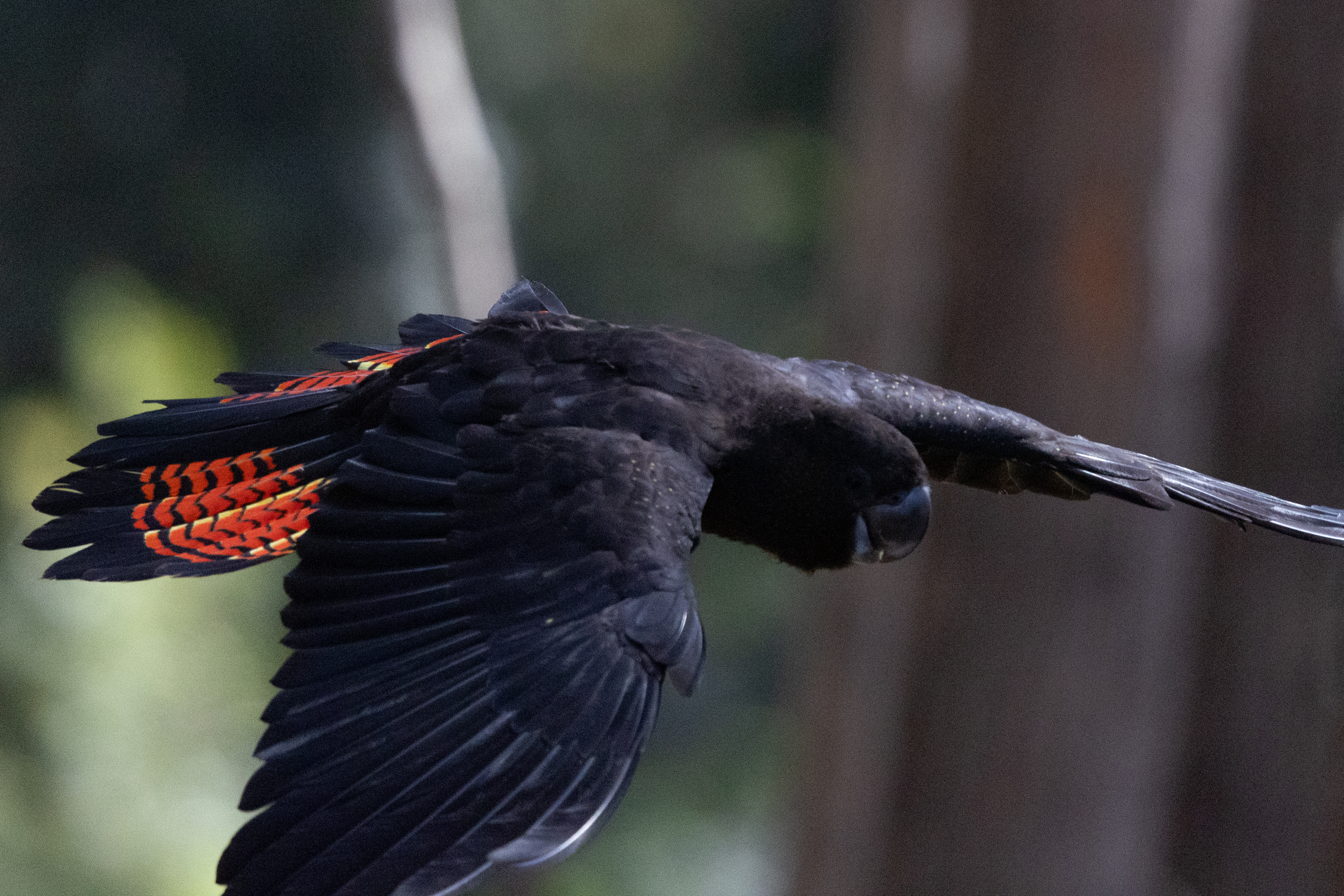
A young bird is especially significant for a species listed as vulnerable in New South Wales, because it shows that a pair has found everything it needs to breed, and the Glossy Black-Cockatoo's needs are very specific. It feeds mainly on the seeds of she-oaks, which the fledgling will learn to prise from their hard cones by watching its parents. To nest, the birds rely on large hollows in old eucalypts, and those hollows can take generations to form. A breeding pair raises just one egg at a time, so every fledgling counts. Across the state, land clearing has removed both feeding trees and nesting trees, and where the two end up too far apart, the birds struggle to breed. Intense or frequent fires add to the pressure, and a hollow that is lost cannot quickly be replaced.
That is why looking after existing habitat matters so much, and that care is part of how Willinga Park is managed. As the property has grown, native planting has expanded alongside each new space and pathway, mature trees have been carefully preserved, and the wetlands and woodlands are cared for as part of the broader landscape. Bird surveys return every season to record which species are using these habitats and how that changes over time.
The trees this species depends on take decades to grow, which means the habitat supporting this young bird was being looked after long before it hatched. Willinga Park will continue its seasonal bird surveys, recording what is seen and caring for these habitats, so that sightings like this one can continue for years to come.
Photos by Alex Johnston


