

A New Pathway for Equine Reproduction
Ovum Pick-Up and ICSI are now available at Willinga Park Vet Hospital
For mare owners planning the next generation of their breeding program, advancements in reproductive medicine are creating opportunities that may not have previously been possible.
Willinga Park Vet Hospital now offers Ovum Pick-Up, known as OPU, through a collaboration with Specialist in Equine Reproduction Dr Gus Ruiz and the University of Sydney Equine Reproduction Team. A new client information guide has been developed to help owners understand the procedure and determine whether OPU and ICSI may be suitable for their mare and breeding program.
OPU involves collecting unfertilised eggs, known as oocytes, directly from follicles within the mare’s ovaries. The recovered oocytes are then sent to a specialised laboratory, where a single sperm is injected into each mature oocyte using Intracytoplasmic Sperm Injection, or ICSI.
The process may provide another reproductive option for:
· Mares that are unable to carry a pregnancy
· Mares that have not produced embryos through conventional embryo transfer
· Performance mares that need only a short interruption to training
· Breeding programs using limited or valuable semen
· Owners wishing to produce and freeze embryos for future use
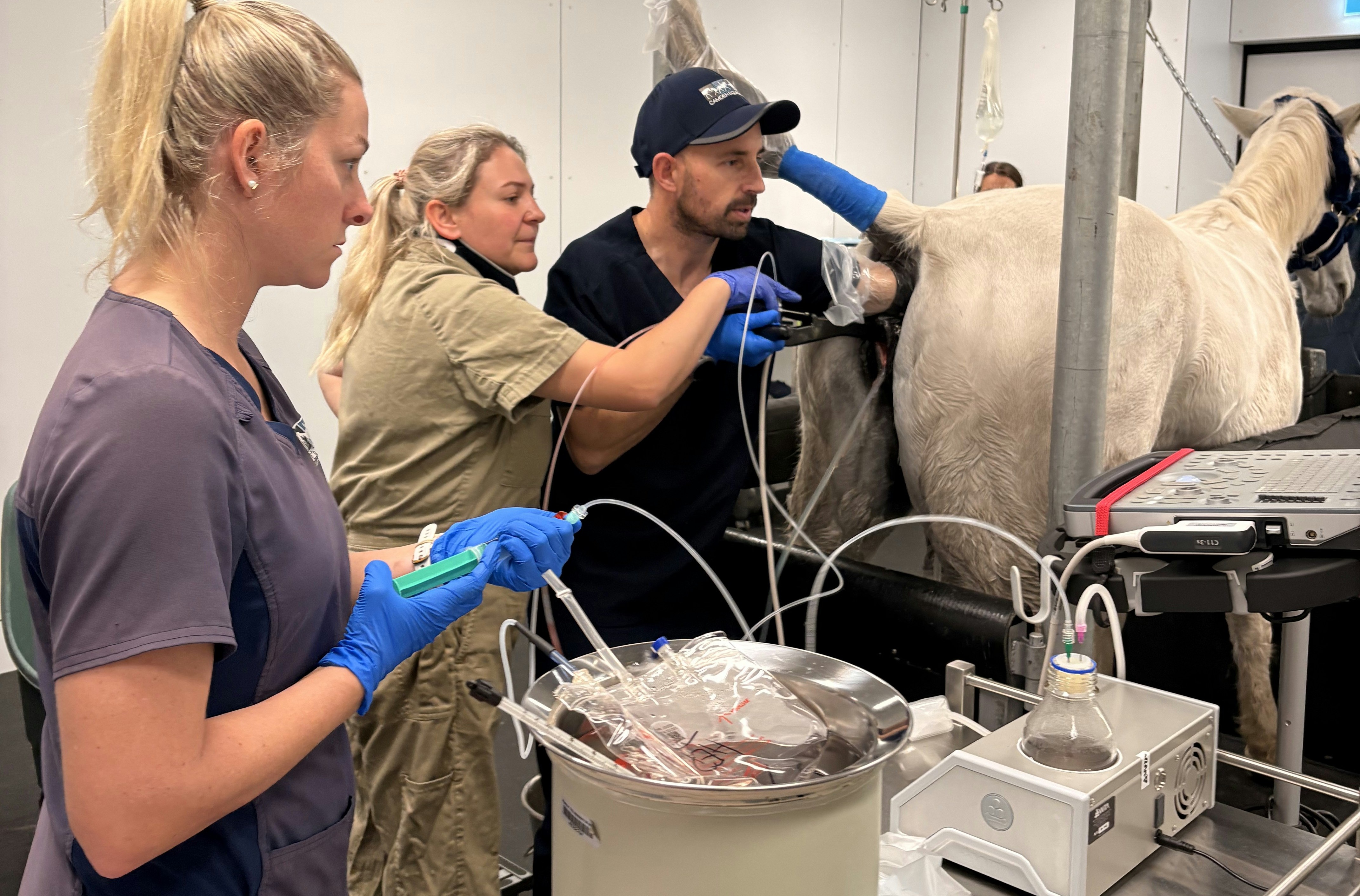
Because ICSI requires only one sperm for each mature oocyte, a single semen straw may potentially be used over multiple sessions. OPU can also be performed outside the traditional breeding season, providing greater flexibility around competition, breeding and recipient-mare availability.
Is every mare suitable?
Not every mare will be an appropriate candidate for OPU.
Mare health, body condition, age, ovarian follicle numbers and reproductive history must all be considered. A veterinary ultrasound is required before the procedure to assess the ovaries and determine whether enough suitable follicles are present.
The procedure is performed under sedation using a specialised ultrasound-guided probe, needle and suction system. Each available follicle is aspirated individually, with the procedure generally taking between 45 minutes and 1 hour. Mares are monitored closely during recovery and should avoid intensive training for at least seven days.
As with any invasive veterinary procedure, OPU carries potential risks. These are uncommon, but may include bleeding, infection, rectal injury, sedation-related complications and inflammation within the abdomen. Mare welfare remains the priority throughout assessment, treatment and recovery.
Understanding the likely outcome
OPU and ICSI do not guarantee an embryo from every session.
Oocyte recovery, maturation and embryo development vary considerably between mares and between individual sessions. The guide explains that the overall chance of producing one or more embryos from a single OPU and ICSI session is approximately 60 per cent, although some sessions may produce no embryo and others may produce more than one. Multiple sessions may therefore be required.
For owners considering this technology, the first step is a conversation with the reproduction team about the mare, the breeding objective and the available semen.
Learn more and download the OPU and ICSI Client Information Guide: https://willingapark.com.au/vet-hospital/reproduction-services